Natural Additives: Richard Anuszkiewicz
11/29/2011
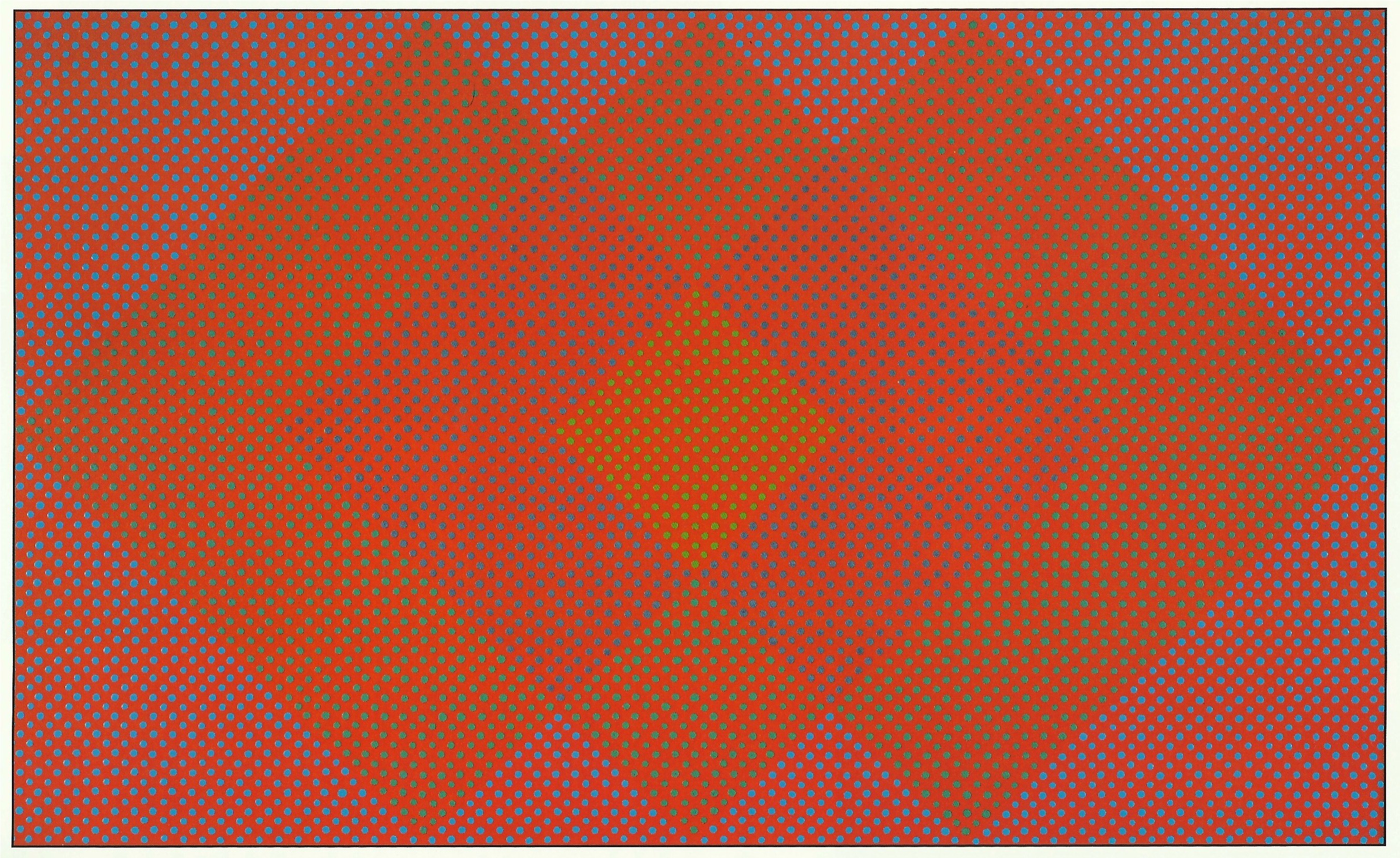
Richard Anuszkiewicz. All Things Do Live in the Three. 1963. Collection of Neil K. Rector. Scanned from Color Function Painting. (click image to enlarge)
At the time of his graduation from the Cleveland Institute of Art in 1953, Richard Anuszkiewicz‘s paintings were realistic. While he could have been called a Midwest regional painter, he felt the work he produced was related to his later nonobjective paintings. In his compositions he had found a greater interest in the shapes than he did the actual subject matter.1 After leaving Cleveland, he attended Yale University from 1953 to 1955 for a Masters in Fine Arts. At the time he had been unfamiliar with Josef Albers.2 However, Albers proved to be a formative teacher, “Alber’s had a tremendous eye for criticism and often talked about Klee and fellow artists from the Bauhaus.”3 From Albers, he learned that colors are never fixed. Instead, they are constantly in flux. Several concepts that Anuszkiewicz learned from Albers reappear in his work throughout his career including factual mixtures, assimilation, and film color. Of his experience at Yale, Anuszkiewicz said, “Albers shook up my whole way of thinking and it took me a couple of years to get myself reassembled.”4
Anuszkiewicz began to solidify his ideas while earning a B.S. in Education from Kent State University in 1955 and 1956. In those years he started to paint abstract canvases with bold colors while studying Gestalt psychology and reading Art and Visual Perception by Rudolph Arnheim.5 “I was working on line-figure-ground relationships, and the effect of contrasting complementary colors, using a reduced palette of two or three colors and using them optically.”6
Working in the additive color mode, Anuszkiewicz painted All Things Do Live in the Three. The 1963 painting on masonite makes use of a solid red ground upon which he hand painted evenly spaced Pointillist style dots in shades of blues and greens. The dots are organized and grouped in such a fashion as to create an illusion of three overlapping diamonds bordered by triangles. The use of visual primaries tricks the eye into seeing these contours. When viewed up close, it is evident that the work has no defining edges and that the dots are of different colors. However, from a normal viewing distance the assimilation effect engages the viewer to take notice of the observed visual cues. As well, from a further distance, some of the diamonds appear to blend into the background leaving the center diamond to become brighter.
The overlapping transparency effect of this painting is called film color. Albers describes film color as being like a “thin, transparent, translucent layer between the eye and an object, independent of the object’s surface.”7 David Katz, a Gestalt psychologist, stated that film color is generally what the viewer sees in the periphery of their vision related to the field and that surface color is related to the figure, or what the eye holds in focus.8 When viewing All Things Do Live in the Three, one sees the dots as the figure. They hold the eyes focus and appear to lift off of the canvas. Perceiving the transparent contours on the surface of the red ground gives the viewer the sense of veils over the surface color.
All Things Do Live in the Three has often been exhibited and well documented in articles, books, and essays. The problem proposed by Anuszkiewicz for this composition lies in the painting’s reliance on additive color to function properly. The execution can be seen as a success as the additive color theories integrated into its construction lead viewers to not only see nonexistent contours, but also misrepresentations of the colored dots. Part of this may be the fault of reproductions, but in each account of the painting writers have consistently described the work differently.
These differences are based on the perceived colors of the dots that make up Anuszkiewicz’s painting. In Contrast to Assimilation: In Art and in the Eye, authors Dorothea Jameson and Leo M. Hurvich discuss the painting as having areas of different hues consisting of the “superposition of blue, green, or yellow dots.”9 Paul Zelanski and Mary Pat Fisher write in their fourth edition of Color that “the light blue, medium green, medium blue, and yellow dots on it change its appearance considerably.”10 Further confusion is created when Grace Glueck writes in the New York Times that the painting consists of dots in oranges and yellows.11 Finally, Floyd Rattlif describes the dots as being blue, green, gray, and yellow green in Color Function Painting.12
Considering the title, All Things Do Live in the Three, along with Anuszkiewicz’s recurring color palette in the early 1960’s and his studies in additive color, suggest – without viewing the work first hand – that the dots would be in hues of blue and green. A review of the D. Wigmore exhibition, “Op Out of Ohio,” in 2010 which included the painting appears to confirm this. Ken Johnson writes how “gridded blue and green dots on a bright red field, the pulsating image seems to lift off the canvas and hover in dematerialized psychic space.”13
The idea that there would be confusion about the true nature of the colored dots is not surprising. This effect is called assimilation. As the colored dots shift the hue of the red background, the perceived changes cause the dots to shift hue as well. This is a discrepancy between the physical and the psychic which Albers explained as forcing the viewer to “’see’ and to ‘read’ other colors than those with which we are confronted physically.”14 They act much in the same way as how the combinations of red, green, and blue lights on a color television or computer monitor blend to create the colors we experience. In this painting the colors work off of one another forcing us to see what isn’t actually there.
1 Grace Glueck, “Blues and Greens on Reds,” New York Times, February 21, 1965, X19.
2 Ursula Kerneitchouk, Geometric Abstraction: A Cleveland Tradition, Cleveland, Cleveland Institute of Art, 1988, 20.
3 David Brooke, Richard Anuszkiewicz: Prints and Multiples, 1964-79, Sterling and Francine Clark Art Institute, Williamstown, 1979, 5.
4 Nicholas Spike, “Op, Op and Away,” Art & Antiques 31 no9, 2008. 63-71.
5 Brooke, Prints and Multiples, 5.
6 Kerneitchouk, Geometric Abstraction, 21.
7 Josef Albers, Interaction of Color, Revised and Expanded Edition, Yale University Press, New Have, 2006, 45.
8 Floyd Ratliff and Sanford Wurmfeld, Color Function Painting, Wake Forest University Fine Arts Center, Winston-Salem, 1996, 16.
9 Dorothea Jameson and Leo M. Hurvich, From Contrast to Assimilation: In Art and in the Eye, Leonardo, Vol. 8, No. 2 (Spring, 1973). 130.
10 Paul Zelanski and Mary Pat Fisher, Color, Fourth Edition, Pearson Prentice Hall, 2003. 28-29
11 Grace Glueck, “Art Review: Only Read Please, Yellow and Blue Are Not Wanted,” New York Times, 2003.
12 Ratliff and Wurmfeld, Color Function Painting, 14.
13 Ken Johnson, “Op Out of Ohio: ‘Anonima Group, Richard Anuszkiewicz and Julian Stanczak in the 1960s’”, New York Times, 2010.
14 Albers, Interaction of Color, 8.
Cleveland in DC part 2: Hugo Robus
11/08/2011

Hugo Robus. One and Another. Bronze. 1934. Smithsonian American Art Museum.
Born and raised in Cleveland, Hugo Robus (1885 – 1964) attended the Cleveland School of Art from 1903 to 1907. There he studied painting under Henry G. Keller. After leaving Cleveland for New York, Robus continued his studies at the National Academy of Design from 1907 to 1909, at which point he traveled to Paris where he saw the 1912 Futurist exhibition at the Galerie Bernheim-Jeune. He began painting in the Cubist and Futurist styles when he returned to New York in 1915. By 1920, Robus devoted his time to creating streamlined figurative sculptures.
On display at the Smithsonian American Art Museum is One and Another from 1934. This sculpture depicts the figures of a mother and her baby. The sweeping form of the woman both suggests a playful and protective emotions that a mother shows towards her child. Maternity is a common theme in Robus’ work, and in this example one can get a sense that the mother is totally engaged by the expression on the infant’s face. Her two arms create a sheltering frame in which the parent and her child exchange gazes. The sculpture captures an intimate moment made more powerful because of its abstract simplicity.
Cleveland in DC part 1: Charles Biederman
11/07/2011
Taking an opportunity to travel to Washington DC, I set out to find Cleveland artists on display at the museums I visited. While I didn’t see as much as I thought I might, the works I did find were both interesting and insightful.

Charles Biederman. Structurist Work #10. Oil on wood and glass. 1939-40. Hirshhorn.
At the Hirshhorn, I came across Structurist Work #10 by Charles Biederman (1906 – 2004). Biederman was born in Cleveland and attended the Cleveland School of art as a teenager after which he took an apprenticeship doing layout for a local advertising agency. In 1926, he moved to Chicago and studied at School of the Art Institute of Chicago despite having dropped out of high school.
Structurist Work #10 exemplifies Biederman’s interest in the strict use of pure geometrical compositions in the style of De Stijl and Contstructivism. Believing that mimetic art had gone as far as it could, that De Stijl’s nature based non-representational two-dimensional geometric representations were obsolete, and the Constructivist’s obsession with the machine and technology was misguided, Biederman sought to combine what he saw as the positive aspects of both movements into his own work.
Biederman applauded that nature based observations of De Stijl artists, as well as the three-dimensional machine made works of the Constructivists. Melding the two, was able make objects in which the changing angles of view and light could be observed. As the viewer approaches Structurist Work #10, the composition changes. This is the result of his layering sheets of glass in a constructed frame. Each pane has its own geometric composition that interacts with the others. The light then also casts shadows onto the inner panes from those in front of them. Should the source of light change, so would the composition of the painting. The austere geometric shapes are directly informed by De Stijl, however the layering of glass is a result of Constructivist theory.
 Perceptual Context